
Reasonable accommodation.
Setting expectations for what we really need.

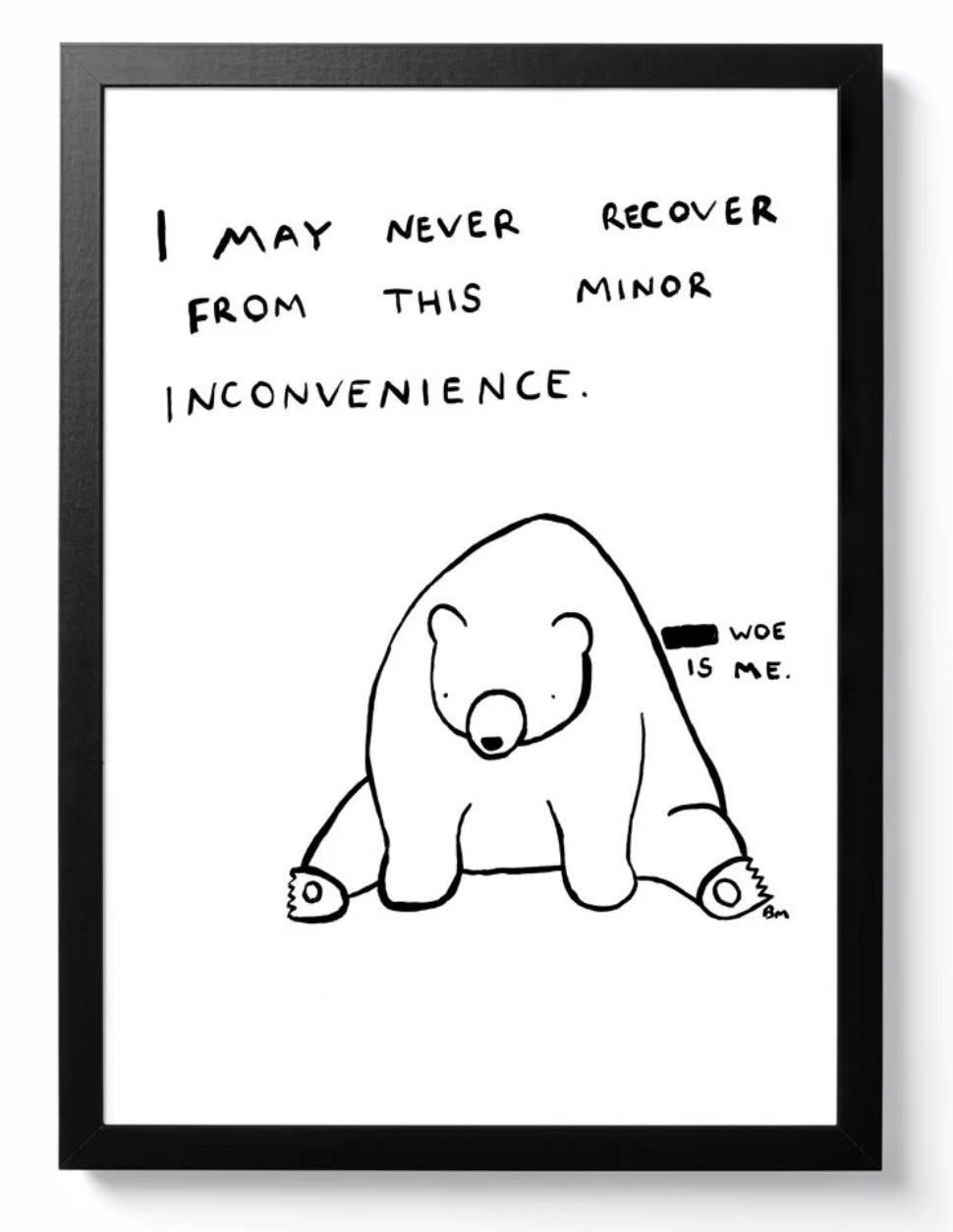
Long before Tommy’s cancer appeared in our lives, a friend gave me a framed illustration with words of wisdom that would become even more relevant in our lives today:
“I may never recover from this minor inconvenience.”
I often tell families facing complex health challenges that diagnosis and treatment are extremely difficult, but it’s the little things in life happening around it that start pushing you closer to the edge.
An inconsiderate patron at the store cutting ahead of your family in line at the checkout. An angry guy on the road honking when you don’t turn quickly enough at a stoplight. A client sending a stern email about a project. A woman refusing to move out of the way on the sidewalk while my amputee son is coming through.
These situations went from minor headaches to massive injustices in the wake of our “cancer year.” How dare the world test us after everything we’ve been through?
None of these perpetrators know they’ve become villains in our story, of course. But the weight of their minor infractions lands heavily on a family living a nightmare.
We thought we’d walk out of the hospital doors and go skipping into a life of freedom and possibility. In some ways, this was true of our experience. The summer after cancer treatment was filled with celebration, travel, and pure enjoyment. It was also mired with confusion about how the world received us–like we had crossed a victorious finish line, ready to take on the next big chapter in life, when we actually felt like we had just crawled back over a ledge after hanging off the side of a building.
Everyone faces big challenges in life. Is ours really so extraordinary? Is it reasonable to expect accommodation in the post-treatment life we’re living, especially from complete strangers or the universe at large? Perhaps I’m asking too much. It can’t be healthy to hold on so tightly to a difficult experience, and yet it has completely and permanently transformed our family.
Or has it?
When I realize Tommy is not yet one year out of treatment, it stops me in my tracks. We’re living a life of extreme, glorious normalcy. He’s going to school, playing sports, and preparing for graduation. Gerd and I are fully back to work. We have dinner together and plan our week ahead the same way we did before. Sometimes it may involve a call to Tommy’s prosthetist, and every three months, maintenance scans remind us that some things are, in fact, a little different now. But on the whole, we’re just living.
This weekend, I spent a day organizing the hall closet, ironing clothes, and cleaning out bathroom drawers. The windows were open, the sun was shining, and a spring breeze was trickling in. I felt a peace I hadn’t felt so deeply in more than 18 months. Days of relative ease compared to last year, when we were moving in and out of the hospital. While I still have my moments of sadness, they have become fewer and farther between.
It occurred to me that I am enjoying the ultimate accommodation: a life with our son still in it, and thriving.
This epiphany makes me feel deeply selfish for wanting a god damn break sometimes. But who wouldn’t want this after nearly a year of caregiving? Families facing cancer treatment for their child are handed a new full-time job in a foreign industry that not only doesn’t pay, but it also drains them financially. It’s tiring, relentless work, even for folks like me with a remarkably undemanding patient. I still experience moments of sheer exhaustion. It made me wonder what I would want for someone in my position if the tables were turned.
I’d want them to experience a life without the everyday stressors we all encounter. No headaches. All healthcare debt canceled. Some kind of financial safety net. Maybe even a free college education for their child.
For families who lose their child, I’d want even more. Paid vacations forever. Someone to prepare and cook all their meals, clean their house, pay their mortgage or rent, immediate retirement… the list could go on. I want justice for the cruelty they’ve suffered.
I’d want unreasonable accommodations for them, for life.
After adapting to the demands that a cancer diagnosis brings, the universe ought to adapt in equal measure. Sadly, that’s not how this ever works. Parents face additional hardship on top of the grief that comes with ushering in a life that is dramatically different from the one they had hoped for previously. Financial consequences, schedule disruptions, the constant surveillance of symptoms and the anxiety that comes along with it. It all feels wildly unfair.
But then I wonder if and how my pursuit of righting the universe's wrongs serves me. There are real, serious issues at play here, including the lack of funding for childhood cancer, an urgent need for treatments with better outcomes and fewer long-term consequences, and barriers to access that far too many families must navigate, to name just a few. Families in our position are left with the burden of fixing what is broken. It can be infuriating, but it’s also an opportunity to remove obstacles for others. And who wouldn’t want to lighten someone else’s load?
I come across a yard sign on my morning walk that reads, “All we can do is take care of each other.” It opens my eyes to a more straightforward desire. My expectation for accommodation is not so much a quest for justice as a calling to be part of a team that supports one another. It’s a simple desire to show up and be helpful in a world that prioritizes self-protection and control.
My hope feels almost too simple. Lighten someone else’s load, or simply get out of their way. This is new wisdom I can embrace.
I’ve been reflecting more on moments of disruption, considering when it makes sense for me to simply take offense or take action. We’re approaching the one year anniversary of post-treatment life. Therapy helped me understand that I had gotten into a sad habit of ignoring what used to be a strong intuition.
I’d known for months that Tommy’s daily ritual of grabbing Advil from the medicine cabinet was not right. I could feel the tingles in my body suggesting that something was off. But for years, I’d been told I often overreacted. My surveillance was too intense, my worries too dramatic. I was too quick to catastrophize, so I actively ignored what I knew to be true: something was wrong.
I’ve spent a lot of time rediscovering my gut. When I feel the jolts in my body, what are they telling me? What’s the best case scenario, the worst case scenario, and the most realistic case scenario? And if I do decide to act, how can I do so with a spirit of care? Maybe it won’t always land well. But at least I can say I’m starting to trust myself again.
When a flight attendant refused to let Gerd board the plane with Tommy and I a few weeks back, I took umbrage with this. But the truth is we got settled in just fine. I figured I’d just let it go. But then I thought about the millions of disabled travelers boarding planes every year, and how this enforcement of an arbitrary rule might impact them. When Tommy told me, “the pre-boarding times lately have been a joke. They barely give passengers a full minute before they call the first class cabin.” I decided to act with care, sending an email about these experiences and asking the airline to do better.
I then remembered a recent experience traveling in Europe. We had scheduled a boat trip down the coast of Cinque Terre. The captain welcomed us when we arrived, mentioning that passengers are kindly requested to remove their shoes before getting on board. When he noticed Tommy using crutches, he instructed him differently.
“That rule doesn’t apply for you. Do whatever you need to get comfortable on board, sir.”
This act of kindness felt like the ultimate demonstration of care. The most reasonable accommodation. It warmed my heart to have a stranger show such consideration for Tommy, especially just a few months into his new chapter as an amputee where simply getting around can feel ten times harder than it used to.
I tell myself to be that captain for others whenever I can. Sure, rules exist for a reason. But just break them when the moment calls for it. Sometimes the adjustments can feel life-changing. Let people do whatever they need to get comfortable on board.